
· by Michael Blair, Nashville's Countertops
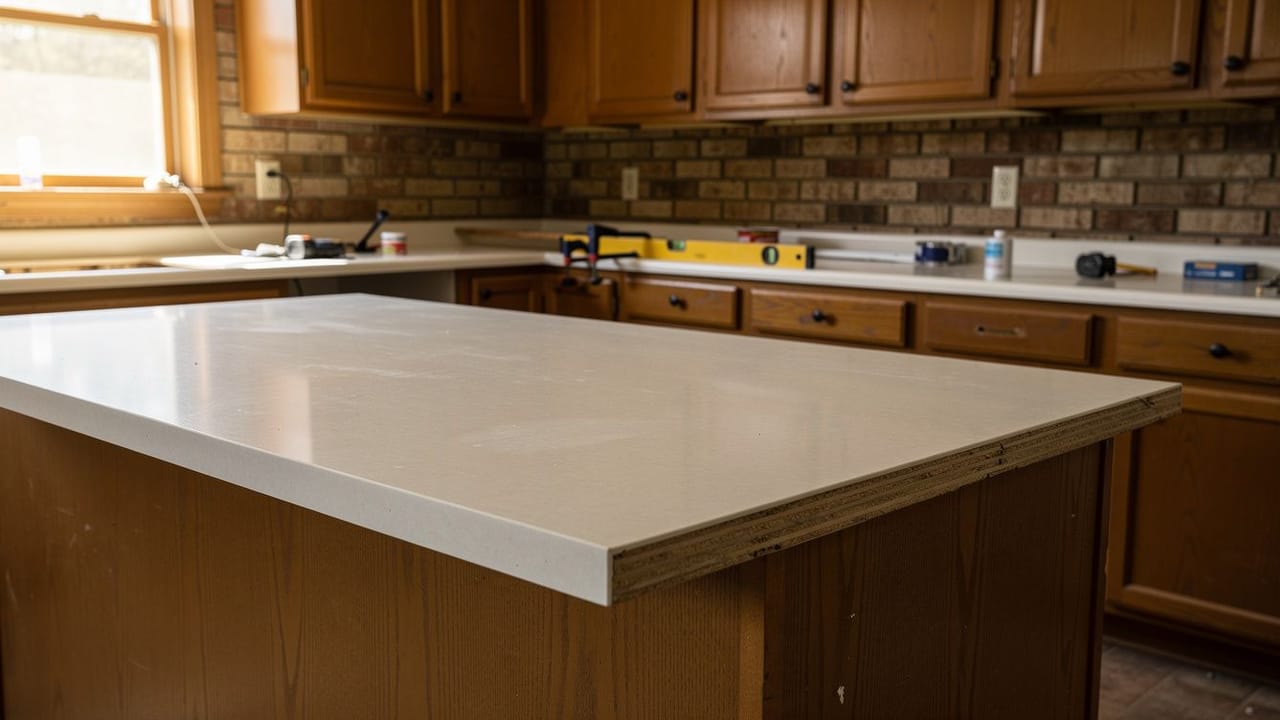
A countertop overlay is a thin sheet of quartz or porcelain cut to the shape of the counter you already have and bonded on top of it, so the old top stays and becomes the base for the new one. People look for it because it skips the tear-out: no prying the old top off the cabinets, no dust from cutting it up, no hauling it out. It is a real option and it suits some kitchens well. It also has fixed limits that come from the method itself, and those are worth knowing before you choose it over a new quartz countertop.
What an overlay is, and what it goes over
The method is simple to describe. The overlay pieces are cut to the footprint of the existing counter and glued down to it. One of the larger overlay franchisors says in the Granite Transformations FAQ that its slabs are made to fit directly over an existing countertop, are adhered with special adhesives, and can go over any hard, durable surface. That last phrase is the whole test, and it is the one we hold an existing top to before we quote one.
Hard and durable rules out more than people expect. A laminate top that is solid and flat is a reasonable base. A laminate top whose particleboard has swollen at the sink, or whose surface has lifted at a seam, is not, because the overlay will only be as sound as what it is glued to. We also check that the old top is flat and level across each run and that it is still fixed tight to the cabinets, since an overlay follows whatever is under it. A top that rocks, dips or sags gets fixed or replaced, not covered.
Edges, sinks and the cooktop
The front edge is where an overlay shows its method. The old counter keeps its thickness, the overlay adds its own on top, and the face of that combined edge has to be covered so it reads as one piece. Our practice is to wrap it with an edge strip of the same material, mitered or butted to the top piece, and to settle on the profile before anything is cut. The edges and sink cutouts we do on full slabs are the same shapes, but on an overlay the profile has to suit a built-up edge, so a thin, crisp edge is easier to get than a deep ogee.
The sink follows the existing cutout. With a drop-in sink, we lift it out, the overlay is cut and finished to the old opening, and the sink goes back in on a fresh bead of sealant on the new surface. An undermount under the old top is a different job, because the old cutout edge sits between the sink and the new surface, and we look at it in person before saying whether it can be finished cleanly. A slide-in range, a cooktop cutout and the dishwasher all see the counter rise by the thickness of the overlay, so each gets measured at the visit along with the backsplash, which may need trimming or resetting.
How it compares with a new slab
The plainest difference is thickness. The quartz overlay described in Granite Transformations’ pros and cons of a quartz overlay is a quarter inch thick and custom-cut to the dimensions of the existing counter. The same page names the trade-off: because the overlay is cut to the shape that is already there, it does not change the layout and it does not give you a thicker countertop. A new slab is cut to whatever layout you want, with the overhang, the island shape and the edge profile chosen from scratch.
Seams follow the same logic. On a new slab, the fabricator decides where seams fall around the sink, the cooktop and the corners, and we covered that in where countertop seams go and why. On an overlay, the pieces still have to be joined where a run is longer than a sheet or turns a corner, but the seams are placed within the old footprint. The time the kitchen is out of use is the overlay’s strength: the same FAQ says no demolition is usually involved, and with the old top staying in place there is no tear-out day and no stretch with bare cabinets.
Weight, heat and when an overlay is the wrong job
Weight is the argument most often made for overlays. Granite Transformations on low-weight countertops describes its top-over-top method and says traditional slabs may need the cabinets or floor joists strengthened. Our practice is the same check either way: we look at the cabinet boxes, the backs and the floor under an island before any stone goes on, because a sagging cabinet is a problem for a thin top and a thick one alike. An overlay does add load to the old top. It just adds less than a full slab would.
A quartz overlay is still quartz, so it is cared for the same way. Caesarstone’s maintenance tips say not to put pots and pans hotter than 300 degrees directly on the surface, warn that sudden temperature changes can damage it, and recommend a cutting board. Porcelain overlays handle heat differently, and the maker of the panel decides that, not us.
- The old top is swollen, delaminating or loose on the cabinets
- You want a different layout, a bigger overhang or a new island shape
- You want a thick edge or a deep profile at the front
- The cabinets are being replaced or moved anyway
- An undermount sink under the old top cannot be finished cleanly
Sources
- Granite Transformations, FAQs — Overlay slabs fit directly over the existing countertop, are bonded with adhesive, and go over any hard, durable surface; no demolition usually.
- Granite Transformations, Pros and Cons of a Quartz Countertop Overlay — Quartz overlay is 1/4 inch thick and cut to the existing countertop; it cannot change the layout or give a thicker countertop.
- Granite Transformations, High Style, Low Weight Countertops — Top-over-top method; traditional slabs may need cabinet or joist strengthening.
- Caesarstone US, 4 Tips to Maintain Your Caesarstone Countertops — No pots or pans above 300 F directly on quartz; sudden temperature changes can damage it; use a cutting board.