
· by Michael Blair, Nashville's Countertops
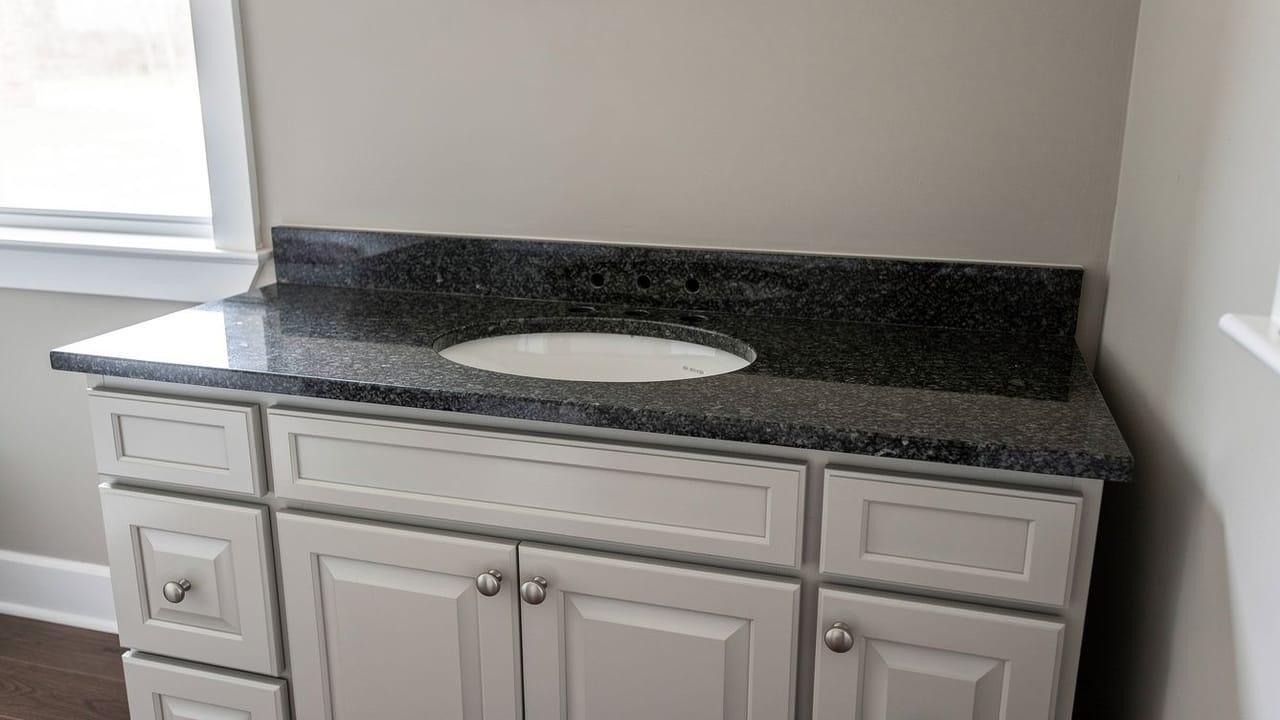
A vanity top looks like a smaller version of a kitchen counter, and the choices sound the same: material, edge, sink. The proportions are what make it different. On a bathroom top the sink opening takes up a large share of the stone, the faucet holes sit a few inches from the wall, and the cabinet underneath is often narrower and lighter than any kitchen base. Every one of those is fixed the day the slab is cut and drilled, and stone cannot be moved over afterward. This is what we settle with you before we fabricate a granite or quartz bathroom vanity top, and what to ask anyone else who quotes one.
The sink opening takes most of the top
On a standard vanity the bowl opening leaves a strip of stone in front of it and a narrower one behind it, between the cutout and the faucet holes. Those strips are where a vanity top is weakest, and they are where it cracks if the cabinet under them gives. A kitchen run has long stretches of solid stone on either side of the sink. A single-bowl vanity often has very little.
One quartz manufacturer puts this in writing. Cambria’s countertop installation technical guideline requires support within three inches of any cutout in its quartz, from a structure that does not deflect, and it calls for rounded corners on cutouts rather than sharp ones, because a square inside corner is where a crack starts. That is Cambria’s rule for Cambria, not a granite rule. We hold granite to the same idea anyway: the frame of the vanity has to carry the stone right up to the edge of the bowl, and every corner we cut is radiused.
Undermount, drop-in and vessel bowls each make a different opening, and we covered the kitchen side of that choice in undermount or drop-in sink with a new countertop. On a vanity the difference is size. An undermount or drop-in bowl removes a large piece of the top, while a vessel bowl sits on the stone and needs only a drain hole, which leaves the top far stronger and puts the faucet question at the front of the list.
Faucet holes are drilled once
The holes behind the bowl are cut in the shop with the rest of the top, along with the sink opening, as part of the edges, sinks and cutouts we do before install. That means the faucet has to be chosen before fabrication, not on the day it goes in. A single-hole faucet, a three-hole faucet on one base and a three-piece faucet with separate handles each need a different pattern, and the hole size and spacing come from the faucet’s own installation sheet. We ask for that sheet, or the model number, at the template visit, and we drill to it.
Placement matters as much as the pattern. The holes have to clear the back of the bowl opening, leave room for a splash against the wall and still put the spout over the drain. A wall-mounted faucet skips the holes in the top altogether, but the supply lines then have to be in the wall before the top is set, which is a plumbing decision that comes first.
Anything else that attaches to the stone gets the same care. Cambria’s guideline says no screw or nail should ever be driven straight through its quartz; where something has to be fixed to the top, it goes into an insert that is glued in. We treat granite the same way, so a soap dispenser or a grab-bar flange that lands on the top is planned and drilled in the shop rather than fastened on site.
A stone top on a lighter cabinet
Kitchen bases are built to carry stone. Bathroom vanities are often furniture-style pieces bought finished, with thinner sides, open legs or a drawer running right under the bowl. Before we template we look at how the cabinet is put together, whether it is fixed to the wall, and whether it sits level and solid on the floor. A top only sits as well as the cabinet does, and a vanity that racks when you lean on it will move the stone with it.
Thin material asks more of the base. Cambria’s quartz guideline requires a full substrate under its one-centimeter tops, which means a solid panel under the whole piece rather than the cabinet frame alone. It also names how the top is fixed down: 100 percent silicone only, a light bead where the stone meets the support, and no layer of adhesive sandwiched between them. And it sets a limit of one-sixteenth of an inch for any visible gap between the top and the wall or the cabinetry next to it.
That gap is the hard part in older Nashville houses, where a bathroom wall is seldom straight for the length of a vanity. It is the reason we template from the cabinet once it is set and level, never from a drawing, as we describe in templating and fabrication and step by step in from template to installation. The top is cut to the wall that is actually there.
Water at the back edge, and whether to seal granite
A vanity is the wettest counter in the house for its size. Water runs down the faucet, stands around its base and sits on the rim of the bowl, and the joint at the back wall gets splashed every time someone washes. The back edge is finished with a short stone splash, a tile splash or a full stone wall, and where the vanity meets a side wall a side splash covers that corner too. We set each splash on silicone so the joint can move without cracking, and we cover the choices in four-inch splash, full-height slab or tile. Water in much of Middle Tennessee is hard, so the white ring that dries around a faucet base shows quickly on a dark top; wiping it dry is most of the upkeep.
Sealing is the question people ask most about granite in a bathroom, and the trade body’s answer is more measured than most sales talk. The Natural Stone Institute’s statement on sealing stone countertops says most granite countertops do not need to be sealed, that in many cases sealing still makes sense because it further reduces how much moisture gets into the stone, and that a quality sealer can last ten to fifteen years. Whether yours needs it depends on the slab, which is why we talk about the specific stone when you choose it. A quartz top is not sealed at all. Our longer notes on care are in sealing and maintaining stone worktops.
Bring these to the template visit and the top can be cut right the first time:
- The sink, or its model number and cutout template, and how it mounts
- The faucet’s installation sheet, or a decision to mount it on the wall
- The vanity set, fixed and level, with any drawer under the bowl known
- Which splash goes on the back wall, and on a side wall if there is one
- For granite, whether the slab will be sealed and with what
Sources
- Cambria, Countertop Installation Technical Guideline (Version 23A-0220) — Cambria’s quartz rules, not granite rules: support within 3 inches of a cutout without deflection; radiused cutout and inside corners; no screws or nails through the top, glued inserts instead; full substrate under 1 cm tops; 100 percent silicone bond with no sandwiched adhesive; visible gaps no more than 1/16 inch.
- Natural Stone Institute, Sealing Natural Stone Countertops — Most granite countertops do not need sealing; in many cases sealing makes sense to further reduce moisture; a quality sealer lasts ten to fifteen years.