
· by Michael Blair, Nashville's Countertops
Sooner or later someone asks whether a quartz countertop can be trimmed or given a new cutout once it is in the kitchen. The stone can be cut, of course; it was cut to get there. The question is where, and with what, because cutting stone dry throws a fine dust that safety agencies have spent years warning fabricators about. Here is what that guidance says, how much silica each countertop material carries, and why our tops arrive with every cut already made.
Is it safe to cut a quartz countertop in the kitchen?
Not with dry tools, and the federal guidance treats the kitchen as part of the problem. The 2026 OSHA and NIOSH hazard alert on silica in countertop work says exposure happens in fabrication shops and also during finishing and installation on site. It names powered hand tools, the saws, grinders and high-speed polishers, as some of the highest sources, and it tells workers to avoid dry cutting, dry grinding, sweeping and compressed air.
The dust is the reason. The alert describes respirable crystalline silica as roughly a hundredth the size of ordinary sand, small enough to reach deep into the lungs, and silicosis as an incurable disease that gets worse over time and can kill. A handheld grinder run dry over a quartz top in a closed kitchen is the setting that guidance is written to prevent.
Does quartz have more silica than granite?
It depends on the product, and the range is wider than most people expect. The hazard alert’s table puts engineered stone, the material sold as quartz countertops, anywhere from less than 0.2 percent to 95 percent crystalline silica, because some products bind the stone in resin and others in portland cement. It lists granite at 10 to 50 percent, slate at 20 to 40, quartzite at 95 percent or more, and marble and limestone at under 5. Soapstone varies.
The same alert reports a NIOSH lab study in which an engineered stone under 0.2 percent silica produced no detectable respirable silica, one under 50 percent produced about as much as granite, and those above 70 percent produced the most. The exact figure for a given slab takes petrographic and X-ray diffraction testing. Quartzite, a natural stone, sits at the top of the table, as our post on checking quartzite before you buy explains, and granite sits in the middle.
Why are countertops cut in the shop instead of on site?
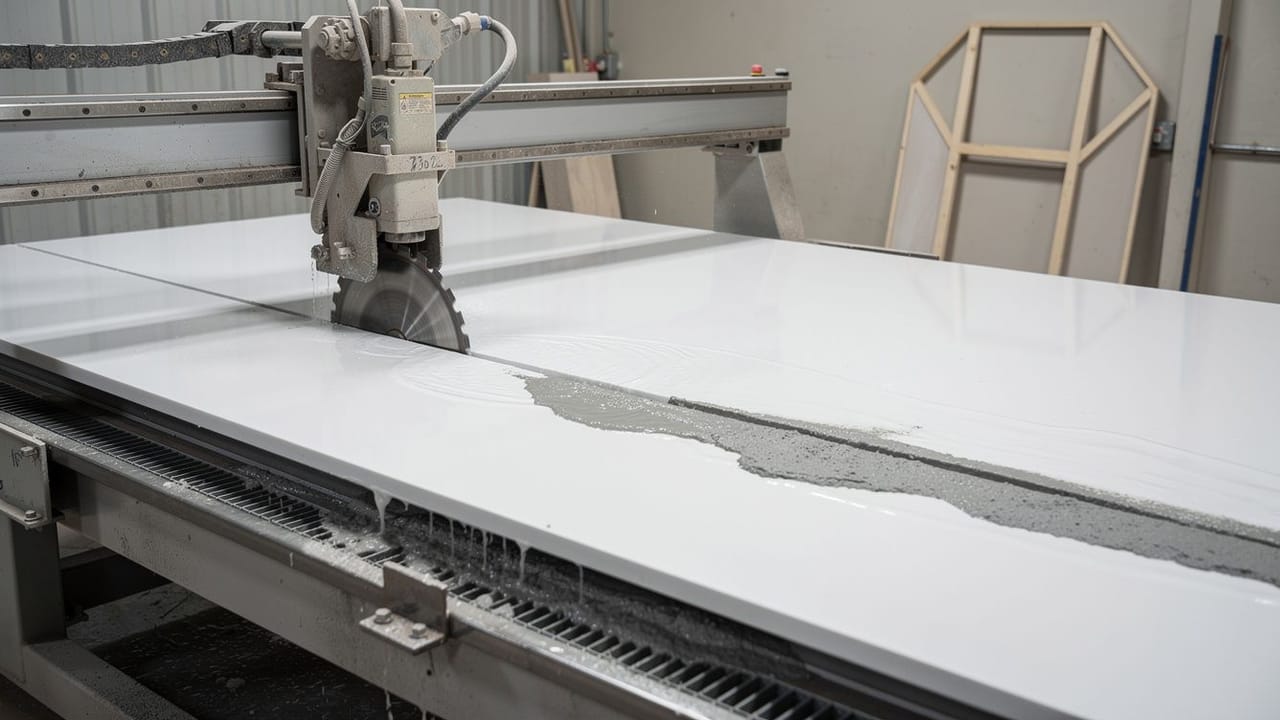
Shop cutting is the main control the hazard alert recommends for residential installs. Its advice to fabricators is to do as much of the work as possible under controlled shop conditions, using laser measurement, mock-ups and templates so a top can be set without finishing work on site. Where on-site work cannot be avoided, it says to do it outdoors and to keep the dust down with water.
Water makes a measurable difference. The alert cites Washington State shop samples that ran from under 40 to 770 micrograms per cubic meter with dry methods, and from under 20 to 100 after the shops switched to wet methods, against an OSHA limit of 50 averaged over an eight-hour day. OSHA’s construction silica standard, 29 CFR 1926.1153, sets that limit and, in its Table 1, calls for handheld power saws fitted with a built-in water feed that keeps the blade wet. Our templating and fabrication work runs this way, so the cutting happens on our saws rather than on your floor.
Cutouts, changes and what to ask a fabricator
Every hole in a stone top is easiest to make before it leaves the shop. Sink, cooktop and faucet cutouts are cut from the template, so the sink model, the cooktop and the number of faucet holes need to be settled before templating day; our edges, sinks and cutouts page and the post on choosing an undermount or drop-in sink cover those choices. A change after install is possible, but the alert’s guidance then applies: outdoors where the piece can come out, water on the tool, and for handheld drills, OSHA’s table calls for a shroud with dust collection.
Ask any fabricator where the top will be cut, whether the cutting and polishing are done wet, and what, if anything, they expect to finish in your house. The OSHA standards bind employers, and the alert itself says it creates no new legal obligations, so the answers tell you how a shop actually works. For a top in Nashville or nearby, ask us for an estimate.
Sources
- OSHA and NIOSH, Hazard Alert: Worker Exposure to Silica during Countertop Manufacturing, Finishing, and Installation (NIOSH 2026-101, OSHA HA-3768-2026) — Exposure in shops and during on-site finishing and installation; powered hand tools among the highest exposures; avoid dry cutting, grinding, sweeping and compressed air; silica content table (engineered stone less than 0.2 to 95 percent, granite 10 to 50, quartzite 95 or more, marble and limestone under 5); shop work, templates and mock-ups over on-site finishing, outdoors with water when unavoidable; Washington State dry and wet sample ranges; NIOSH lab results by silica content; not a standard or regulation
- OSHA, 29 CFR 1926.1153, Respirable Crystalline Silica (construction), via Cornell Legal Information Institute — Permissible exposure limit of 50 micrograms per cubic meter as an eight-hour time-weighted average; Table 1 controls: integrated water delivery for handheld power saws, shroud and dust collection for handheld drills
FAQ
Cutting Quartz Countertops: Why It Stays in the Shop — questions
Can you cut a quartz countertop at home?
Not safely with dry tools. The 2026 OSHA and NIOSH hazard alert names saws, grinders and polishers among the highest sources of silica dust and tells workers to avoid dry cutting and grinding. Where a cut on site cannot be avoided, it says to work outdoors and use water. We make every cut in the shop under water.
Does quartz have silica?
Most quartz countertops do. The OSHA and NIOSH hazard alert lists engineered stone at anywhere from less than 0.2 percent to 95 percent crystalline silica, depending on whether the stone is bound in resin or in portland cement. The exact content of a given product takes petrographic and X-ray diffraction testing, so the maker’s data is worth asking for.
Can a sink cutout be made after the countertop is installed?
It can, but it is the harder way. Cutouts are normally cut from the template in the shop, so settle the sink, cooktop and faucet holes before templating. If a change cannot wait, the OSHA and NIOSH alert says to do the work outdoors where possible and keep the dust down with water.
Is quartz countertop dust dangerous?
The dust from cutting, grinding and polishing is the concern. The OSHA and NIOSH alert says respirable crystalline silica is roughly a hundredth the size of sand and can cause silicosis, an incurable lung disease that worsens over time. Its advice is wet methods, shop work over site work, and no dry sweeping or compressed air.
Does granite have silica?
Yes. The OSHA and NIOSH hazard alert lists granite at 10 to 50 percent crystalline silica, below the highest-silica engineered stones and well below quartzite at 95 percent or more. Marble and limestone sit under 5 percent. Granite is cut with the same wet methods as quartz, because its dust carries silica too.