
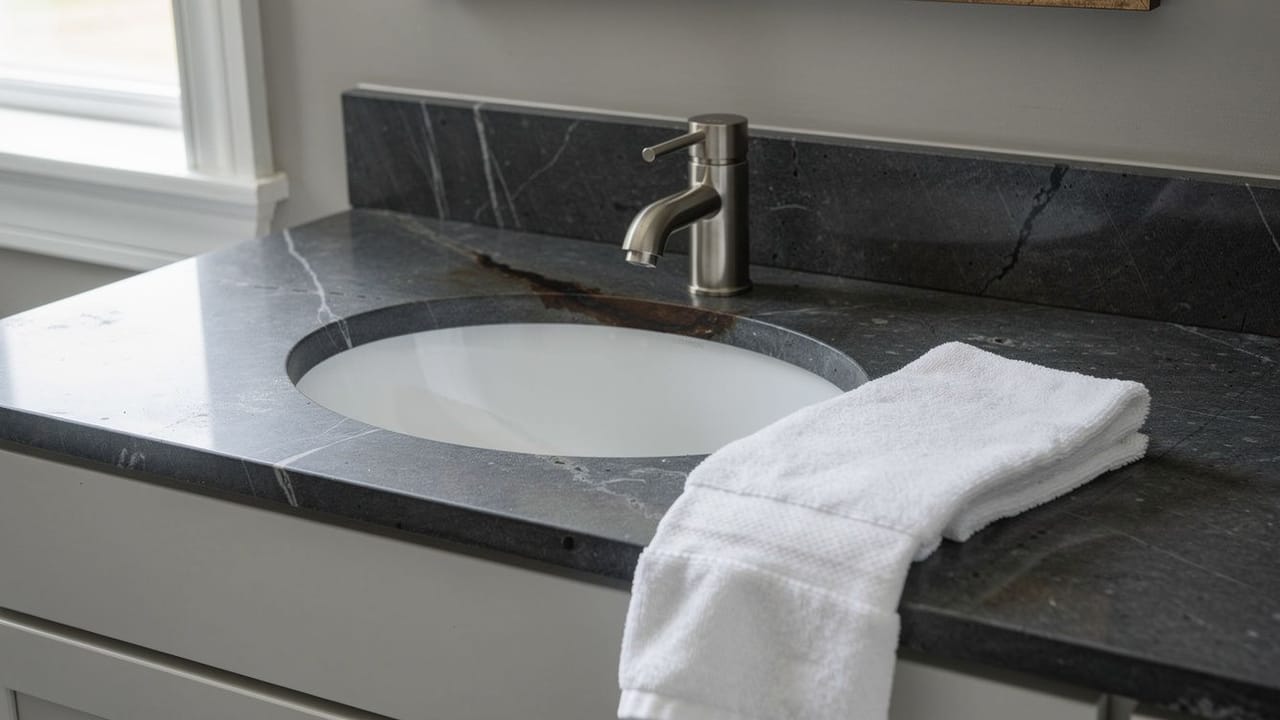
· by Michael Blair, Nashville's Countertops
Most people choosing a vanity top know granite and quartz, and know that granite gets sealed. Soapstone gets asked about less often and works almost the other way around. It is soft enough to scratch, it is not sealed, and its color changes over the years whether you do anything or not. The care advice for it comes mostly from the quarries that produce it, so below it is attributed to them by name rather than presented as an industry standard. If you are comparing materials for a bathroom, our bathroom vanity tops page covers how we template and cut a vanity, whatever the stone.
Why isn’t soapstone sealed like granite?
Because it is not porous, and its producers advise against it. Polycor, which quarries Alberene soapstone, says in its Alberene soapstone care and maintenance guide that the stone does not need sealing and recommends that it not be sealed. Whatever is spilled sits on the surface, the guide says, and cleans off with soap and water. The same guide calls it resistant to heat and to acids.
Vermont Soapstone gives the same picture in its soapstone FAQs: the stone is non-porous and chemically neutral, so things like lemon juice and alkaline cleaners do not affect it. That is the main difference from the granite and marble care in our post on sealing and maintaining stone, where the sealer is the protection. With soapstone there is no sealer to wear off.
Why does soapstone get darker, and how do you darken it on purpose?
Soapstone darkens because liquid on the surface darkens it and it lightens again as it dries, so a top in daily use slowly develops a darker patina where it is used most. Oil or wax evens that out by darkening the whole top at once. The two producers give different schedules. Polycor suggests mineral oil weekly for six to seven weeks and then about every three months, or a dry wax weekly for three weeks and then every 8 to 12 months, and notes that mineral oil can look blotchy. Vermont Soapstone says to oil weekly for the first two or three months, then monthly or less, and explains that the oil evaporates, so the stone lightens again over time.
Neither schedule is required. Polycor’s guide says the stone needs no treatment at all if you like the natural look, which darkens a little with age on its own. Oil and wax are a choice about color, not protection.
Is soapstone better suited to a vanity than a kitchen?
For the darker, settled look, a vanity can be the easier place for it. Polycor names one treatment that its guide does not recommend for kitchen countertops but says works well on vanity tops: a chemical darkener, applied roughly once at the start and then about every five years, in place of the regular oil or wax. A vanity also sees no knives, pots or heavy pans, which is where soapstone’s softness shows in a kitchen.
Scratches are the trade-off on either. Polycor says most fade under the next coat of wax or oil and do not need a professional; deeper ones can be sanded out with 80, then 120, then 200 grit paper and re-treated. Vermont Soapstone adds two cautions worth asking a fabricator about. It prefers 1-1/4 inch thickness for counters and sinks, and it describes stone sold as a harder soapstone as usually serpentine, which it does not recommend. For an undermount bowl, the Vermont Soapstone undermount sink installation guide says 1-1/4 inch stone needs no sub-base, and that the sink should be supported from below on 3/4 inch plywood set on 2x4s, with the lip caulked.
What to settle before a soapstone vanity is cut
Settle the thickness, the sink and how it will be supported, the edge, and whether you want the top oiled before it leaves the shop or left to darken on its own. Those are the same decisions as for any vanity, covered in our post on granite vanity tops, with the stone’s source added: ask which quarry a slab comes from, so you know whose care guide applies and whether it is soapstone or serpentine.
If you are weighing soapstone for a bathroom in Nashville or nearby, send us the vanity size and sink and we will talk it through against the other stones before anything is templated.
- Thickness: Vermont Soapstone prefers 1-1/4 inch
- Sink support from below for an undermount bowl
- Oil, wax, darkener or nothing, and who does the first coat
- Which quarry the slab comes from
Sources
- Polycor, Alberene Soapstone Care & Maintenance — No sealing; heat and acid resistance; oil, wax and darkener schedules; darkeners suited to vanity tops; scratch repair
- Vermont Soapstone, FAQs — Steatite and talc content; serpentine; 1-1/4 inch thickness; non-porous and chemically neutral; why and how often to oil
- Vermont Soapstone, Undermount Sink Installation Guide — No sub-base for 1-1/4 inch stone; sink supported on 3/4 inch plywood over 2x4s; caulked lip
FAQ
Soapstone on a Bathroom Vanity: Sealing and Patina — questions
Do soapstone countertops need to be sealed?
No. Polycor, the producer of Alberene soapstone, says the stone does not need sealing and recommends against it, because it is not porous and spills sit on the surface. Vermont Soapstone also describes it as non-porous and chemically neutral. Clean it with soap and water, and use oil or wax only to change its color.
Can you use mineral oil on soapstone?
Yes, to darken it evenly. Polycor suggests oiling weekly for six to seven weeks, then about every three months, and notes it can look blotchy. Vermont Soapstone says weekly for the first two or three months, then monthly or less. The oil evaporates, so the stone lightens again over time.
Does soapstone scratch easily?
It is soft and does scratch, but Polycor says most scratches fade when the next coat of wax or oil goes on and do not need professional repair. Deeper scratches can be sanded with 80, then 120, then 200 grit paper and re-treated. On a bathroom vanity there are fewer knives and pans to scratch it.
What is the difference between soapstone and serpentine?
Vermont Soapstone describes soapstone as steatite, at least half talc, with architectural soapstone usually 60 to 75 percent talc. It says stone marketed as a harder soapstone is usually serpentine, a different stone it does not recommend. Ask which quarry a slab comes from before it is cut.
How thick should a soapstone vanity top be?
Vermont Soapstone prefers 1-1/4 inch for countertops and sinks, and its undermount guide says stone at that thickness needs no sub-base. The sink itself is supported from below on 3/4 inch plywood set on 2x4s, with the lip caulked. Confirm the thickness with your fabricator before templating.